Maya Bay: What Actually Happens When You Visit Thailand's Most Famous Beach
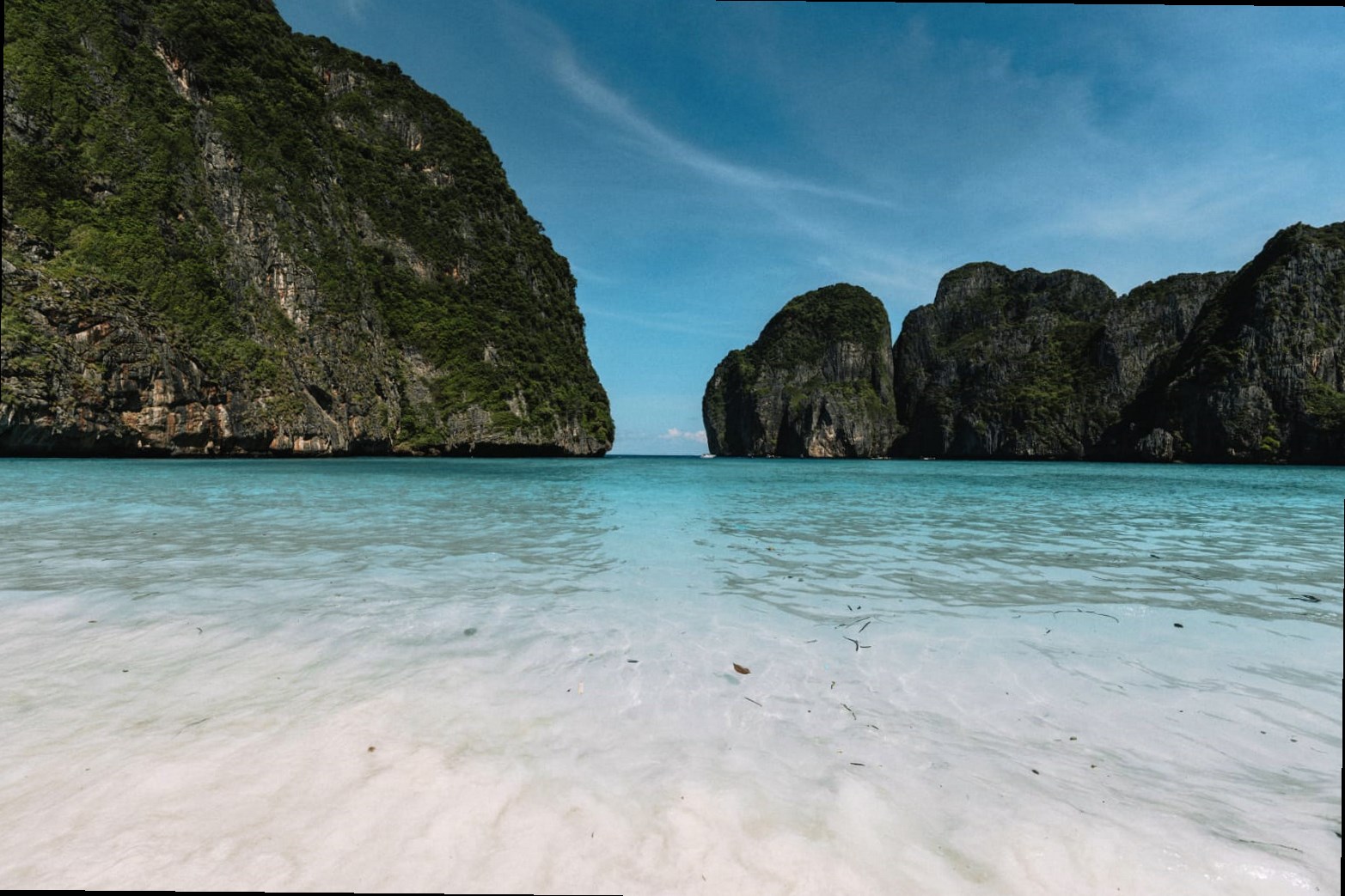
Maya Bay carries more baggage than almost any beach in Thailand.
Twenty-five years after Leonardo DiCaprio wandered its sand in The Beach, it still has the appeal.
It's the name most travelers throw around when planning a Krabi or Phuket trip. What most people don't know until they arrive is how differently the bay actually operates now compared to the version on screen or even the version from ten years ago.
Here's the full picture, pulled together from tour operators, national park rules, and people who've walked that boardwalk recently.
Where Maya Bay Sits
Maya Bay is tucked into Ko Phi Phi Leh, the smaller and uninhabited half of the Phi Phi island duo. It sits inside Hat Noppharat Thara-Mu Ko Phi Phi National Park in Krabi province.
Sheer limestone cliffs wrap around three sides of a crescent bay, with water that shifts from pale turquoise to deep blue depending on the hour.
No one lives on this island.
Visitors arrive by boat and leave by boat, usually within an hour.
A Short History Worth Knowing
The bay's fame traces back to 1999, when 20th Century Fox shot The Beach here and altered the natural dune landscape to fit the film's aesthetic. In the process, they planted non-native vegetation (palm trees) and altered the beach with machinery to suit the filmmaking.
Just to give an idea of the severity of this:
Messing with the natural habitat of a place in any way, especially by taking out native plants and planting plants not of that area, causes lasting damage to the ecosystem.
Local environmentalists sued the production company and Thai officials over the damage.
The film released in 2000 and, while it underperformed at the box office, it built a cult following that sent tourist numbers climbing for nearly two decades.
By 2018, daily visitor counts had reportedly hit 7,000 to 8,000 people.
Sadly, the coral reef paid the price. Reef fish and blacktip sharks largely vanished from waters that couldn't handle the traffic.
The Thai government shut the bay down entirely in June 2018.
Marine scientists and volunteers spent years on rehabilitation, including replanting more than 30,000 pieces of coral.
The bay reopened in January 2022 with a completely different operating model, closed again briefly in August 2022 for further adjustments. Then settled into the system still running today.
In a separate legal thread, Thailand's Supreme Court upheld an agreement requiring 20th Century Studios to pay 10 million baht toward the rehabilitation effort.
This is a fairly rare instance of a film studio footing part of the bill for damage caused decades earlier.
The Rules Now in Place
This surprises the first-time visitors most. Maya Bay today runs less like a beach and more like a managed conservation site.
| Rule | Detail |
| Entry fee | 400 baht for foreign adults, 200 baht for children, paid in cash |
| Opening hours | Roughly 7:00 AM to 4:00-6:00 PM daily (varies slightly by season) |
| Annual closure | August 1 through September 30, for ecological recovery during monsoon |
| Visitor cap | Around 4,125 people per day, split into groups of roughly 375 |
| Time on the beach | Typically capped near one hour per visit |
| Swimming | Not permitted, wading up to the knees only |
| Sunscreen | Banned near the water, since oxybenzone damages coral |
| Other bans | No eating on the sand, no drones, no touching coral, no feeding wildlife |
Officials patrol the shoreline and use whistles to warn anyone wading too far out.
Break the rules, and you're looking at a fine, not just a stern word.
Getting There: Every Route Broken Down
There's no direct ferry stop at Maya Bay itself. Every trip runs through a tour, whether booked independently or through a hotel desk.
From Phuket
- Full-day speedboat or catamaran tours run 1,500 to 3,200 baht per person
- Usually includes lunch, snorkeling gear, and stops at other islands like Bamboo Island or Pileh Lagoon
- Travel time to the Phi Phi area runs around 1.5 to 2 hours each way
From Krabi or Ao Nang
- Half-day longtail boat tours from Koh Phi Phi itself run 800 to 1,200 baht per person
- Full-day tours from Krabi mirror the Phuket pricing structure
- Many operators combine Maya Bay with nearby snorkeling stops in the same trip
From Koh Phi Phi Don (the inhabited island)
- Shortest and cheapest route, since Phi Phi Leh sits close by
- Half-day tours are the standard option here, often departing early to beat the day-trip crowds from the mainland
The final approach
No matter which route gets you to Phi Phi Leh, boats are barred from entering the bay itself.
Every vessel docks at a floating pontoon around the back of the island, in an area called Loh Samah Bay.
From there, visitors walk a boardwalk through the forest, past a small hut staffed by park officials, before reaching the crescent beach on the other side. The full walk takes somewhere between five and fifteen minutes depending on the crowd moving through it.
Timing Your Visit
Crowd control is the single biggest factor in whether Maya Bay feels magical or frustrating.
Visitors who've been recently consistently point to the same window: arrive right at the 7:00 AM opening, or come back in the late afternoon after 3:00 PM. Midday slots, especially between 10:00 AM and 2:00 PM, bring the heaviest tour group traffic and the longest lines on the boardwalk.
One practical tip that keeps showing up across independent blog write-ups: most visitors cluster on the left side of the beach near the main photo spot. Walking further right, past that crowd, tends to open up quieter stretches of sand with far fewer people in your shot.
What There Actually Is to Do
Given the one-hour time limit and the no-swimming rule, activities here are more limited than people expect, but not nonexistent.
- Walk the shoreline. The cliffs alone are worth the visit. Towering, dramatic, and genuinely photogenic from nearly every angle on the beach.
- Spot the blacktip sharks. Juvenile blacktip reef sharks have returned to the shallows since rehabilitation began, and they're harmless to people. Seeing them dart through the shallows has become one of the more talked-about moments visitors report.
- Snorkel outside the bay. Since swimming inside Maya Bay itself is off-limits, most tours add a snorkeling stop nearby, often at Pileh Lagoon or Bamboo Island, both known for clearer water and healthier reef.
- Photograph the driftwood welcome sign. A small, simple wooden marker near the entrance has become the unofficial photo spot for anyone wanting proof they made it.
Setting the Right Expectations
Anyone chasing the exact scene from The Beach will be disappointed.
That version of Maya Bay, with empty sand and no restrictions, doesn't exist anymore, and honestly, rightly so.
The current setup trades a bit of spontaneity for a beach that's actually recovering rather than one being loved to death.
Coral cover has improved, marine life has partially returned, and the crowds, while still real, are at least capped and managed rather than left to grow unchecked.
Travelers who've visited recently tend to land on the same conclusion: it's worth the trip, but only if expectations are calibrated beforehand.
Come expecting a managed conservation site with a strict schedule, not an untouched paradise, and the visit tends to land well.
Come expecting total exclusivity, and the whistles and queues will feel like a letdown.
Quick Reference Before You Go
- Pack reef-safe or no sunscreen for the bay itself, since standard sunscreen isn't allowed near the water
- Bring cash for the entry fee if it isn't already bundled into your tour price
- Wear shoes suited for a boardwalk and sand transition, not just flip-flops
- Time your booking for an early morning or late afternoon slot if your tour operator offers a choice
- Don't plan on swimming, and don't expect to linger past your allotted hour
Maya Bay remains one of the most photographed patches of sand in Southeast Asia for good reason.
The setting is still etheral.
What's changed is the experience around it, shaped by years of damage, a genuine rehabilitation effort, and a set of rules that, love them or not, seem to be working.